
MACHAME ROUTE
MACHAME ROUTE
Climbing Mount Kilimanjaro via the Machame route means sharing the mountain with numerous other trekkers.
As budget operators began utilizing Machame, traffic on the route surged. It soon surpassed the Marangu route as the most heavily trafficked climb on Mount Kilimanjaro.
This increase isn’t solely due to dropping prices. The Machame route is widely regarded as the most scenic path up Kilimanjaro.
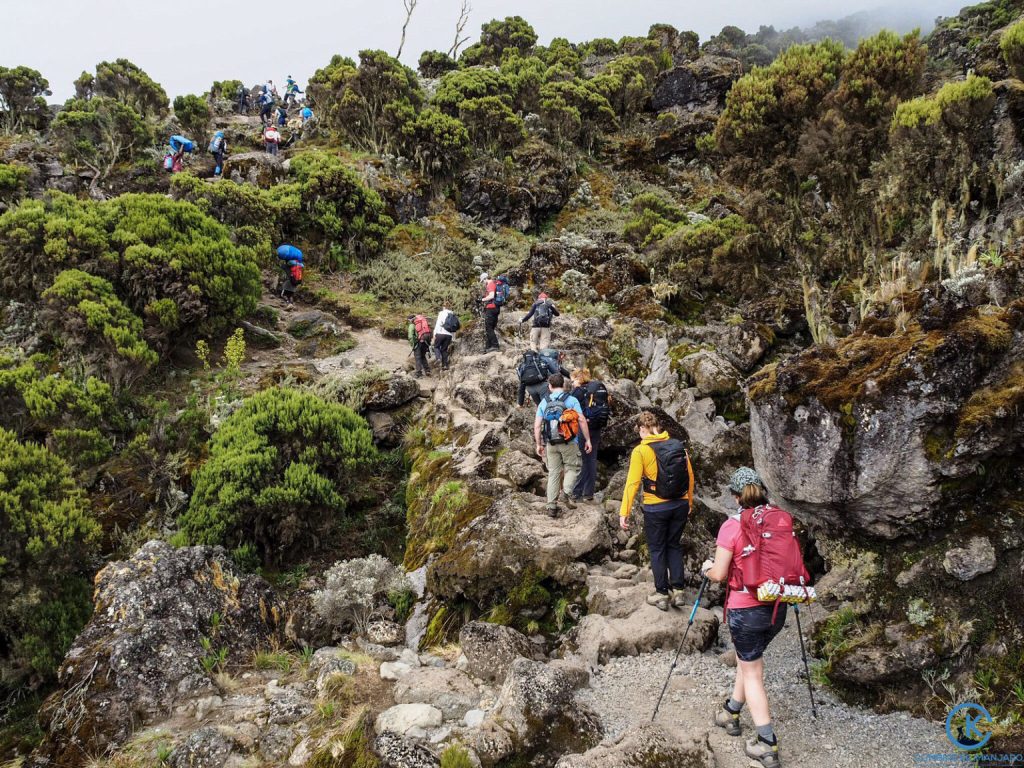
However, that’s not entirely accurate. The Machame route is indeed very scenic, but it’s not the only one. Both the Shira and Lemosho routes merge with the Machame path after the first day or two. These routes are less crowded and typically longer, making them more expensive.
It’s more precise to say that Machame is the most scenic Kilimanjaro route that budget operators offer.
(Whether climbing Mt. Kilimanjaro with a budget operator is advisable is another question.)
Climbing Kilimanjaro via the Machame route is considered more challenging than the Marangu or Rongai routes.
It’s jokingly referred to as the “Whiskey Route,” implying a tougher climb than the “Coca Cola route” (Marangu). Despite being more difficult, success rates are higher on Machame compared to Marangu!
The Machame route is more strenuous but not technically difficult.
It is simply a longer and often steeper trek, covering more ground with more ups and downs. It requires more energy rather than skill. However, it offers much better acclimatization!
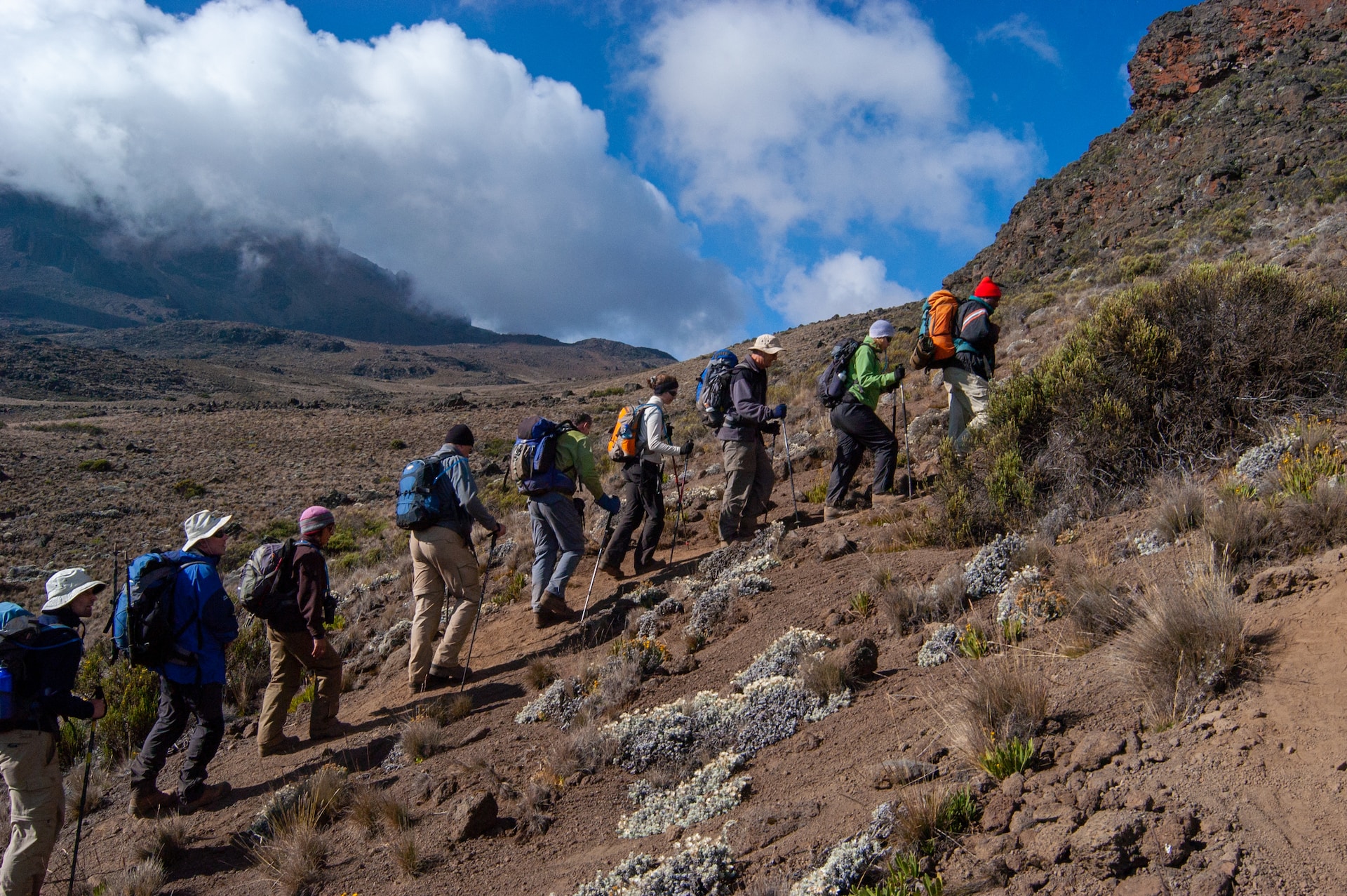
Some people are terribly worried about climbing the Barranco Wall. Don’t worry. It’s not a cliff face and it’s not a climb. It’s mostly a very steep path that requires you to use your hands occasionally and to scramble a bit in a few places.
If you are concerned, either about the scrambling or the fitness demands, then consider the Rongai route. For a detailed discussion on which route might be the best for you, see this page about all climb routes.
For a detailed description of the Kilimanjaro climb on the Machame route, read below.
Machame Route Itinerary
The following itinerary describes the six-night/seven-day Kilimanjaro climb on the Machame route, presenting one possible variation of this route.
To condense the itinerary to six days, you would omit the night in the Karanga Valley and proceed directly from the Barranco Huts to the Barafu Huts in one day.
In theory, you could extend the trek to enhance your summit chances, but if you have the means for a longer trek, the Shira or Lemosho routes offer better options. They share the same scenic path for the last four days to the summit but provide genuine wilderness and solitude in the initial days.
For experienced mountaineers, there’s also a challenging and perilous specialist route via the Western Breach.
(Note: Altitudes and distances are approximate and may vary depending on different sources.)
Starting Point: Machame Gate (1830 m/6000 ft)
Duration: 6-7 days
Day 1 – Machame Gate (1830 m/6000 ft) – Machame Huts (3030 m/9940 ft)
Distance: 5.5 km/3.5 miles
Time: 5-7 hours
Altitude Gain: 1200 m/3940 ft
Day 2 – Machame Huts – New Shira Camp (3850 m/12630 ft)
Distance: 5.5 km/3.5 miles
Time: 4-6 hours
Altitude Gain: 820 m/2690 ft
Day 3 – New Shira Camp – via Lava Tower (4640 m/15220 ft) – Barranco Huts (3985 m/13070 ft)
Distance: 10 km/6.2 miles
Time: 5-7 hours
Altitude Gain: 135 m/440 ft (790 m/2590 ft to Lava Tower)
Day 4 – Barranco Huts – Karanga Camp (4040 m/13255 ft)
Distance: 5.5 km/3.5 miles
Time: 4-5 hours
Altitude Gain: 55 m/185 ft
Day 5 – Karanga Camp – Barafu Huts (4680 m/15360 ft)
Distance: 3.5 km/ 2.2 miles
Time: 4-5 hours
Altitude Gain: 640 m/2105 ft
Day 6 – Summit Attempt via Stella Point (5752 m/18871 ft) to Uhuru Peak (5895 m/19340 ft) and Descent via Mweka Route to Millenium Camp (3820 m/12530 ft) (or to Mweka Hut)
Ascent Distance: 5 km/3 miles
Descent Distance: 10 km/6.2 miles
Ascent Time: 5-6 hrs + 1-2 hours up
Descent Time: 5-6 hours down (overall walking time may vary from 10 – 16 hours)
Ascent Altitude Gain: 1072 m/ 3511 ft (Stella Point) or 1215 m/3980 ft (Uhuru Peak)
Descent Altitude Loss: 2075 m/6810 ft
Day 7 – Millenium Camp – Machame Gate
Distance: 20 km/12.5 miles
Time: 5 hours
Descent: 1990 m/6530 ft
Climbing Mt. Kilimanjaro – Machame Route – Day 1
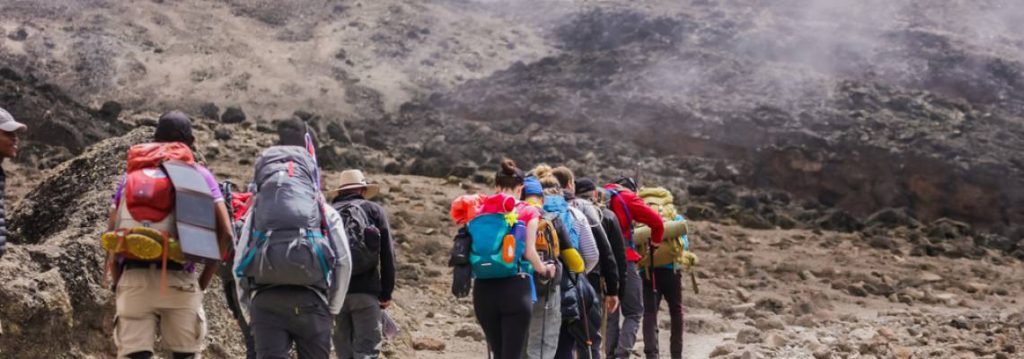
Your Kilimanjaro journey commences with a transfer from your hotel to the village of Machame and the Machame gate, a roughly 50-minute drive from Moshi.
Weather permitting, the drive to the gate should be smooth, but heavy rainfall might render the final stretch impassable for vehicles, necessitating a walk.
Upon arrival at the gate, you’ll meet your guides and porters, complete registration formalities, and set off.
Your equipment is already in the hands of the porters, who may have forged ahead of you. The Machame route traverses the rainforest zone, known for its high precipitation levels—approximately 96% of Kilimanjaro’s rainfall occurs here.
It’s essential to have sturdy boots and rain gear from the outset, as well as adequate protection for your belongings in case of showers or muddy terrain. The initial portion of the trail follows a four-wheel drive track before transitioning into a well-defined footpath.
The rainforest envelops you in its enchanting ambiance, with lush greenery, mist, dangling moss and lichen, sheltering tree ferns, and vibrant ground flora like impatiens and violas.
After approximately two and a half hours, you’ll reach a clearing near a stream for lunch. The journey resumes through similar terrain until you arrive at the Machame Huts Camp, your accommodation for the night.
As you progress, the forest gradually thins, offering glimpses of the majestic Kibo peak if weather conditions permit.
Climbing Mt. Kilimanjaro – Machame Route – Day 2
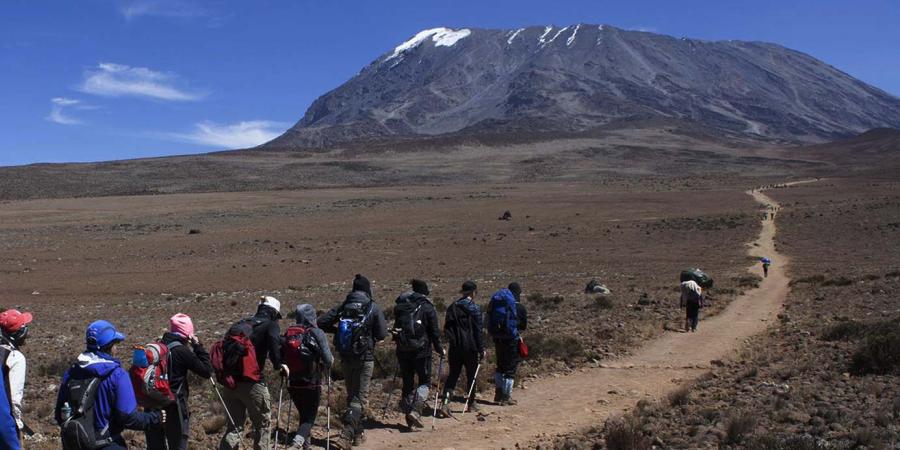
Reaching the Machame Huts signifies the transition from the montane forest to the expansive moorland zone adorned with towering heathers. With the vegetation opening up, weather permitting, you’ll be treated to splendid vistas. From here, you can spot Kibo, Mt. Meru in the distance, and even catch a glimpse of Machame down below as you ascend towards the Shira Plateau.
Incidentally, the Shira Plateau remains as a remnant of Kilimanjaro’s third peak, alongside Kibo and Mawenzi.
Today marks your first encounter with the imposing giant senecios and lobelias lining the path.
The trail becomes notably steeper, particularly until you reach your lunch spot. Fortunately, today’s trek is relatively short. After lunch, it’s just an hour or so to the edge of the Shira Plateau, where your camp awaits.
Although you’ve covered less ground, the ascent in altitude may start to take its toll on some individuals. As the taller vegetation fades away, the landscape transforms into a more rugged, mountainous terrain.
Tonight, your tent promises to offer unparalleled views: Kibo, the Western Breach, the Shira Cathedral, and the Needle. It seems like no coincidence that many of the most captivating sunset photographs of Kilimanjaro are captured from this vantage point.
Climbing Mt. Kilimanjaro – Machame Route – Day 3
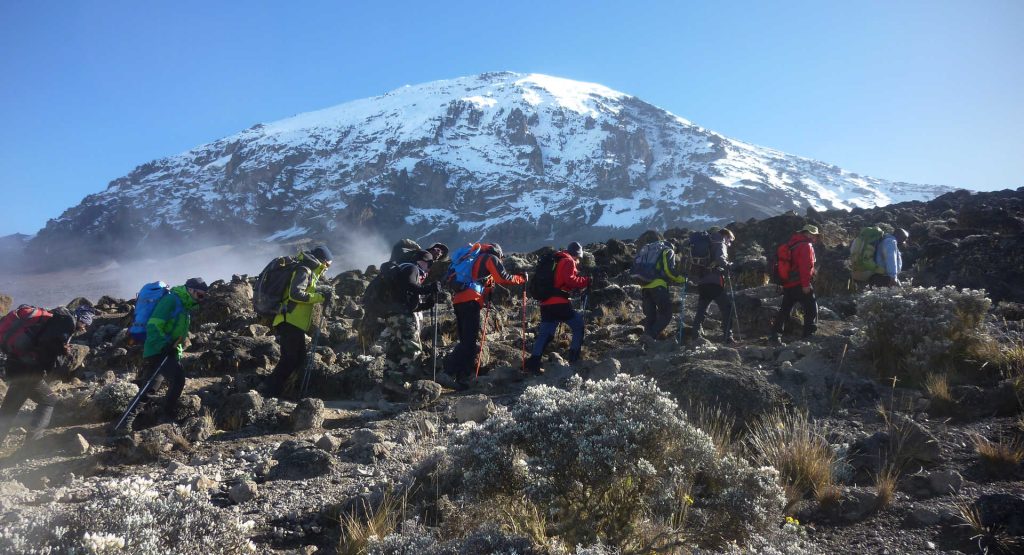
Today’s journey is a demanding one. You’ll begin by ascending towards the Lava Tower, a prominent volcanic plug rising 100 meters (300 feet) above the surrounding terrain. This geological feature is a relic of Kilimanjaro’s volcanic past, and as you approach it, the landscape becomes increasingly sparse. Even the short heather disappears, revealing the rocky ground of the lava ridges.
While the climb may not be as steep as yesterday’s, it’s often perceived as more strenuous, as you’ll be ascending to an altitude of over 4500 meters, where the effects of reduced oxygen are noticeable.
Following a well-deserved lunch break near the Lava Tower, you’ll descend into the picturesque Barranco Valley, formed by a massive landslide around 100,000 years ago. Enclosed by towering cliffs, this valley boasts lush greenery, with the return of senecios and lobelias. From here, you’ll enjoy sweeping views across the plains below and catch your first glimpse of the imposing Barranco Wall, which you’ll tackle tomorrow.
Barranco Camp stands out as the most spectacular campsite on this route, offering breathtaking vistas of Kibo, the Western Breach, and the initial southern glaciers. It’s a fitting reward after a challenging day.
If you experience slight symptoms of altitude sickness, it’s not uncommon given the altitude you’ve reached today. However, by adhering to the principle of climbing high and sleeping low, you’re providing your body with optimal conditions for acclimatization. Although you’ve lost some hard-earned altitude, today’s focus on acclimatization is crucial for your overall success.
Regardless of whether climbers arrived at Barranco Camp via the Machame, Shira, Lemosho routes, or even a special route around the northern circuit, from this point onward, all climbers follow the same trail.
Kilimanjaro Climb on the Machame Route – Day 4
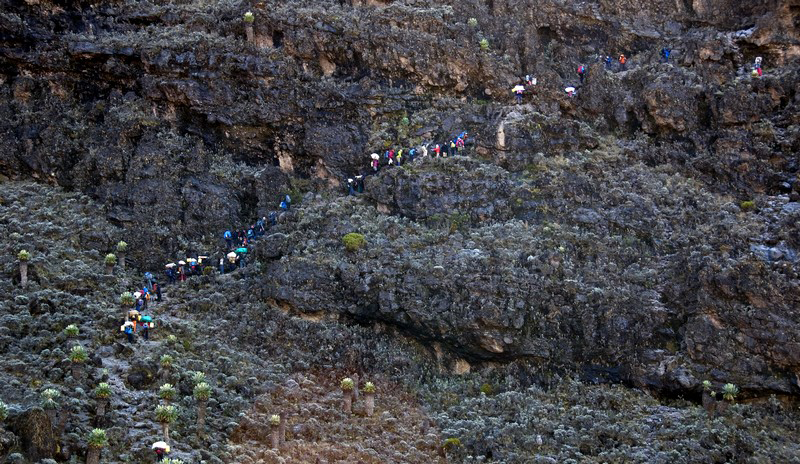
Today, bright and early, your adventure begins with the ascent of the Barranco Wall.
There are tales circulating about the Barranco Wall demanding significant climbing expertise, being nearly insurmountable, or posing perilous risks. However, I’ve found these to be exaggerated.
While the climb is challenging due to the thin air and steep incline, it doesn’t necessitate climbing experience. Although the exposed nature of the wall may give pause to those without mountain experience, it’s entirely manageable. You’ll use your hands for stability, but for the most part, it’s a straightforward ascent. Only at a few points will you need to scramble, which doesn’t require prior experience.
As you ascend, be sure to pause occasionally to admire the panoramic views, including the procession of climbers behind you.
Scaling the wall typically takes about an hour and a half. Upon cresting the final ridge, you’ll be greeted by a breathtaking vista of Kibo, seemingly within arm’s reach.
After a brief respite to soak in the awe-inspiring scenery, you’ll descend on a gentler slope. From here, it’s a couple more hours traversing volcanic scree and traversing several small valleys until you arrive at the Karanga Valley Camp.
Nestled within the narrow and steep Karanga Valley lies a verdant oasis, albeit chilly and windswept. The camp, situated on the opposite side of the valley, entails another ascent. With the afternoon at your disposal, you can rest, explore, or attempt to capture the perfect shot of one of the iridescent, malachite sunbirds that inhabit the area.
Kilimanjaro Climb on the Machame Route – Day 5
Today’s trek is relatively brief. Departing from the Karanga Valley, you’ll traverse an easy yet steep path, navigating through an increasingly rugged terrain with the imposing Southern Glaciers looming to your left. The incline progressively steepens until you arrive at Barafu Camp for a well-deserved lunch.
The additional night spent at Karanga proves advantageous, affording ample time to dine, rest, recuperate, and make final preparations for the impending summit attempt. You might even have the opportunity for a brief acclimatization hike before indulging in another meal and retiring early. Tonight marks the pivotal moment.
Situated on an exposed ridge amidst a desolate and barren landscape, Barafu Camp exudes an otherworldly ambiance. It’s advisable to familiarize yourself with the surroundings before nightfall; wandering in the dark to locate facilities can pose a risk, given the camp’s precarious location on the ridge.
Kilimanjaro Climb on the Machame Route – Day 6
I trust you’ve arrived at Barafu Camp early enough to ensure plenty of rest. (Those on shorter treks might have skipped Karanga Camp and therefore may not have had the same opportunity.)
Ensure your day pack is prepared with all the essentials for tonight: rain gear if not already worn, an adequate supply of water, hand warmers, balaclava… Verify that your head torch and camera have fresh batteries, and confirm you’re already dressed appropriately. Make sure everything you’re wearing is completely dry!
Today is likely to be etched in your memory as one of the most physically challenging days of your life. It’s also likely to be one of the earliest starts you’ve ever experienced…
Your guides will awaken you sometime between 11 pm and 1 am. While there may be some hot drinks and perhaps a light snack, the focus will primarily be on emerging from your sleeping bag, adding additional layers of clothing, donning your boots and head torch, grabbing your day pack, and setting off…
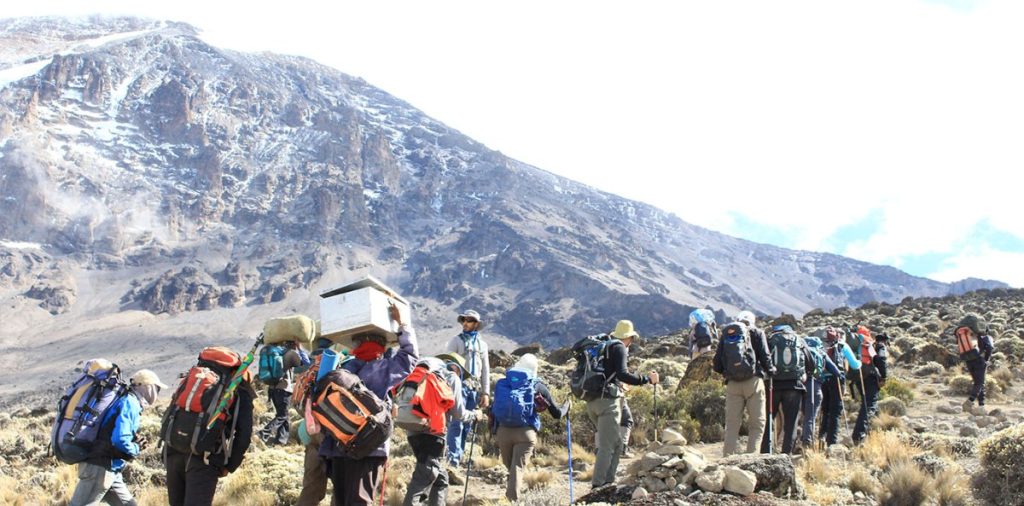
After navigating some small cliffs to depart from Barafu Camp, the path becomes more discernible. Yet, it isn’t long before a sharp left turn marks the beginning of the arduous ascent—a seemingly endless series of switchbacks snaking up the steep slope of loose volcanic scree that defines Kibo Peak’s flank.
Though the path, thanks to its switchbacks, isn’t overly challenging, the loose scree makes progress difficult, with each step a struggle against gravity and the thinning air. The altitude’s effects may be profound, leaving you feeling dreadful. Take your time; don’t rush. Ignore any urge to speed up, regardless of other groups overtaking you.
Reaching Uhuru Peak or the rim by sunrise isn’t crucial; your safety is. Move steadily, focusing on one step at a time. Altitude sickness symptoms like headaches and nausea are common; vomiting, though unpleasant, is not alarming.
Breaks are brief in the frigid temperatures, as the cold quickly seeps into your extremities. As you cross a frozen stream and spot nearby boulders, you’re nearing the rim. The final stretch, though steep and challenging, must be conquered. You’ve come too far to turn back now.
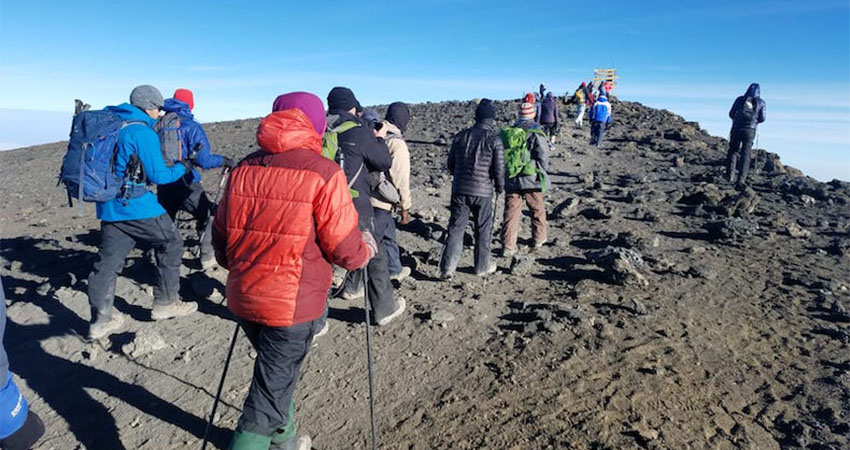
Most climbers take five to six hours to reach Stella Point. If you’re slower, don’t fret. The dawn’s arrival rejuvenates spirits, providing a burst of energy for the final ascent. Soon, you’ll stand at 5752 m/18871 ft, basking in the glow of the rising sun.
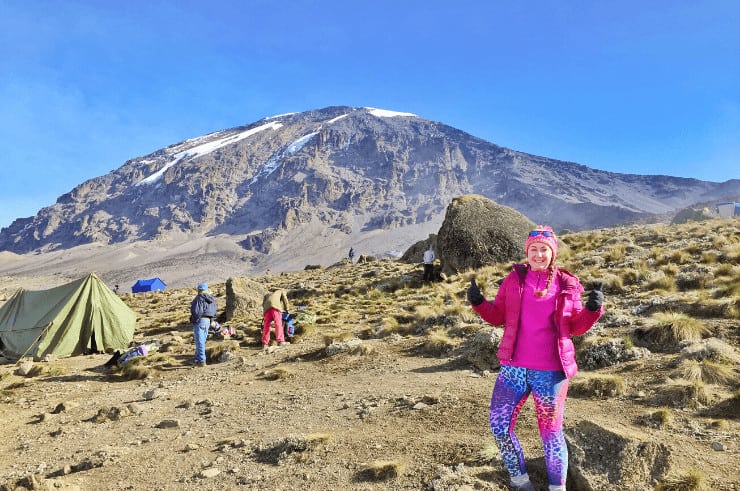
Congratulations on your achievement! You’ve accomplished a remarkable feat!
The park authorities will recognize your efforts with a certificate, whether or not you choose to proceed along the crater rim to Uhuru Peak.
Reaching the crater rim at Stella Point, rather than Gilman’s Point like on the Rongai and Marangu routes, offers a distinct advantage: while the ascent to Stella Point may be challenging, the journey to Uhuru Peak from there is only 45 minutes. However, don’t be fooled—this final stretch is no cakewalk.
Although many find the climb to Stella Point to be the toughest part, traversing the rim can also present its own challenges. The prolonged exposure to extreme altitude takes its toll, with each uphill step becoming increasingly arduous.
While some may find it effortless, it’s wise to prepare for the worst and be pleasantly surprised if it proves easier than anticipated. It’s always better to be over-prepared than underprepared at such high altitudes.
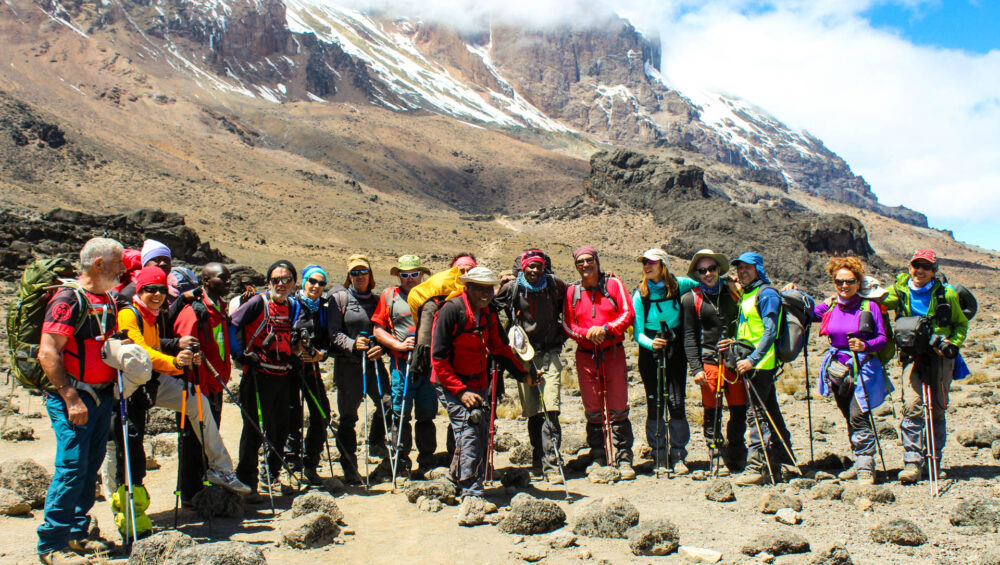
Congratulations once again! What you’ve achieved is truly remarkable, and no matter what you anticipated, the reality of it will be entirely different. Climbing to nearly 6000 meters altitude is an experience that defies description or imagination.
Now it’s time for hugs and photos. There won’t be much time for anything else, as it’s too cold and dangerous to linger at this altitude for long.
You’re probably completely drained of energy by now. But guess what? The day is far from over—it’s just getting started, and it’s another long one.
You’ll need to make your way back to Stella Point first. From there, it’s a descent of nearly 1100 meters, down, down, down… until you reach Barafu. The descent can be tough on the knees, so you’ll be grateful for your walking poles!
If you choose to scree run, it’s not so bad. In fact, it can be quite enjoyable and fast! But spare a thought for those who have to trudge back down the same switchbacks they climbed up earlier.
Lunch should be waiting for you at Barafu, but you’ll probably just want to collapse and sleep. However, after exerting yourself so much today, it’s not safe to stay at this altitude. You’ll have to gather your gear and keep moving, heading down for several more hours to reach Millenium Camp or Mweka Huts, depending on your tour company’s choice.
As you descend further, you’ll start to breathe in air again—oxygen, lots of it! Oxygen is life, and it will rejuvenate you. Despite how you feel now, there’s a good chance that after this additional descent, you’ll actually feel better and more energetic than you did at lunchtime.
Dinner will likely be a lively affair, with everyone’s eyes shining as they share their experiences of the day. And there’s no doubt that you’ll sleep well tonight!
Kilimanjaro Climb on the Machame Route – Day 7
After breakfast, you begin your descent, down, down, down. It’s your last day on the mountain, and you might struggle to muster enthusiasm for your surroundings.
What you’ll likely notice more is the steepness of the path, especially on the steepest sections that wreak havoc on your tired knees.
The day’s journey takes you through some truly beautiful forests teeming with birdlife. Try to find some interest in it—it may provide a distraction from the pain.
Upon reaching the gate, there are more formalities to endure, but eventually, you bid farewell to your guides in a sad and emotional moment. Then, you climb into the waiting vehicle and are whisked away to your hotel for hot showers and cold beers.