
Arusha National Park
Arusha National Park
Arusha National Park (ANAPA) is a treasure trove of diverse ecosystems and stunning vistas of Mt. Meru, the crater that lends its name to the region.
It is a favored destination for day-trippers departing from Arusha town before embarking on longer safaris through the northern circuit. This compact national park encompasses the slopes, summit, and ash cone of Mt. Meru, the Momela Lakes, Ngurdoto Crater, and the lush highland forests adorning its lower slopes. Game viewing around the Momela Lakes unfolds at a leisurely and tranquil pace, with many visitors pausing amidst the forest to seek out troupes of rare colobus monkeys frolicking in the canopy.
Climbing Mt. Meru or exploring the network of smaller trails that crisscross its lower slopes is a popular pursuit for Arusha National Park visitors. The three-day trek to reach the crater’s summit offers a quieter and, some argue, more challenging alternative to the renowned peak of nearby Mount Kilimanjaro. Along the lower slopes, pathways leading to rivers and waterfalls provide a serene day hike option for those seeking a less demanding excursion. Ancient fig tree forests, crystal-clear waters cascading from mountain streams, and opportunities to spot colobus monkeys are among the park’s many attractions.
As the closest national park to Arusha town—northern Tanzania’s safari hub—Arusha National Park is a multi-faceted gem often overshadowed by more popular safari destinations, despite its offering of diverse habitats to explore within a short drive.
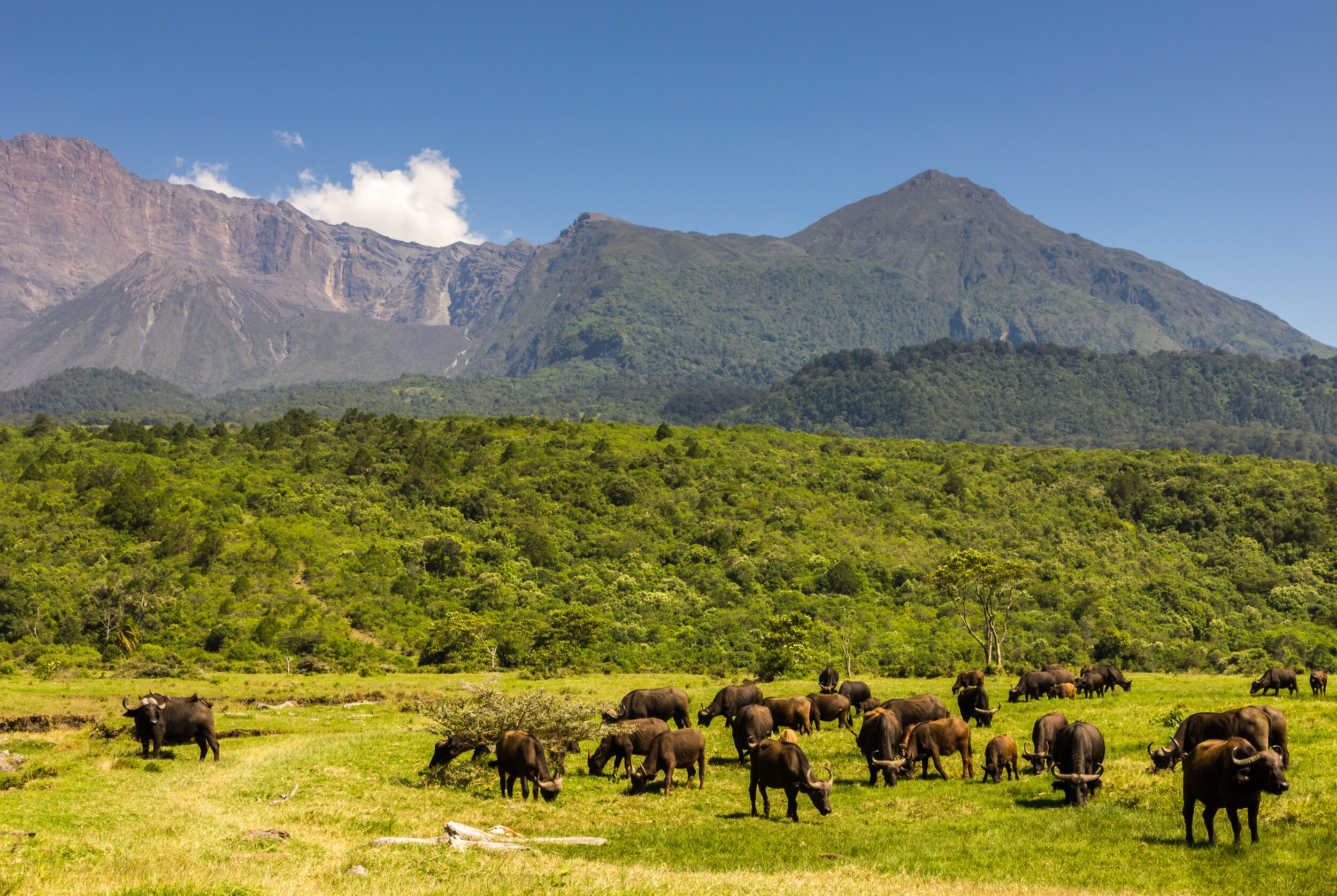
The park’s entrance gate opens into a shadowy montane forest inhabited by curious blue monkeys and vibrant turacos and trogons—a unique feature of the northern safari circuit where the acrobatic black-and-white colobus monkey is commonly sighted. Nestled within the forest lies the striking Ngurdoto Crater, its steep rocky cliffs enclosing a broad marshy floor dotted with herds of buffalo and warthog.
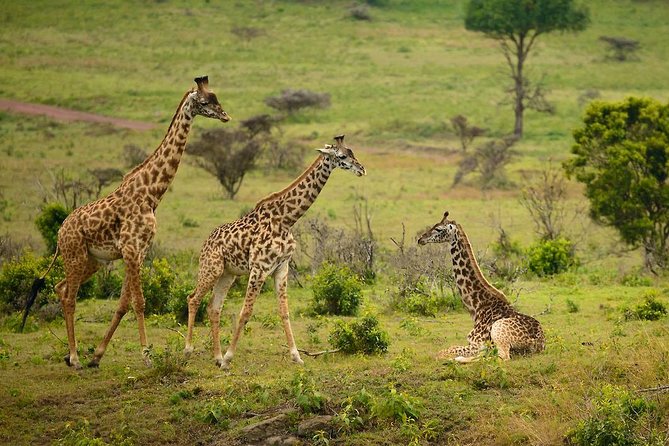
To the north, rolling grassy hills embrace the serene splendor of the Momela Lakes, each displaying a unique shade of green or blue. Occasionally, the shallows are tinted pink by thousands of flamingos. These lakes provide a habitat for a diverse array of resident and migratory waterfowl, as well as shaggy waterbucks showcasing their large lyre-shaped horns along the water’s edge. Giraffes gracefully traverse the grassy hills, weaving between herds of grazing zebras, while pairs of wide-eyed dik-dik dart into scrubby bushes resembling oversized hares on spindly legs.
Although elephants are rare in Arusha National Park, and lions are completely absent, leopards and spotted hyenas may be observed skulking around during the early morning and late afternoon. It is during these times, at dusk and dawn, that the veil of cloud on the eastern horizon is most likely to dissipate, revealing the majestic snow-capped peaks of Kilimanjaro, located only 50 km (30 miles) away.
However, it is Kilimanjaro’s unassuming counterpart, Mount Meru—the fifth highest mountain in Africa at 4,566 meters (14,990 feet)—that commands the park’s skyline. With its peaks and eastern foothills protected within the national park, Meru provides unrivaled views of its renowned neighbor while also serving as a rewarding hiking destination in its own right.
Beginning with a journey through wooded savannah where encounters with buffalos and giraffes are common, the ascent of Meru leads through forests adorned with red-hot pokers and draped with Spanish moss, before transitioning into open heathland punctuated by towering lobelias. Everlasting flowers cling to the alpine desert, while delicately-hoofed klipspringers mark progress along the hike. Atop the rugged summit, Kilimanjaro is laid bare, blushing in the glow of the sunrise.
Size:
552 sq km (212 sq miles).